From Brent to Biryani: How Oil Drives Inflation
- Nithya A
- Jun 11
- 5 min read

The famous Calicut biryani that every tourist swears by, just went from Rs 90 to Rs 120. Vendors say they cannot sustain business at the old rates due to the rising LPG prices.
Not just biryani and not just in Kerala, prices of commodities across India are rising. In May, price of Amul curd increased by Rs 3 per half litre and tomatoes hit Rs 50 per kg. Curd, tomatoes, biryani – common everyday items in your shopping list are already impacted. The engine driving these costs up is fuel. Petrol has been hiked four times in a month and now sits at Rs 105-110 per litre depending on your city.
Not just consumers, even corporations are struggling with rising input costs. HUL, Godrej, Dabur, Britannia are set to increase their prices or reduce the quantity of the product. Shrinkflation just became a viable business plan.
If we take a step back in the supply chain, we find Oil Marketing Companies (OMCs) like IOCL, BPCL and HPCL, who buy crude oil, refine it into petrol and diesel, and sell it to you at the pump. In the first few weeks of a price shock, they can keep retail prices unchanged because India holds crude and fuel inventories, including commercial stocks with OMCs and strategic reserves, that were bought at lower prices. Over time, however, they have to buy new crude at the higher global price. If pump prices are still frozen, their marketing margins get squeezed and financial stress starts to build.
The finance ministry then decides if it wants to step in with excise duty cuts to ease the tax burden on fuels. These cuts create room for price management as well as liquidity relief for OMCs. This helps prevent them from slipping into operational losses despite the higher cost of imported crude. A classic Catch‑22: if there is no excise duty cut, your petrol bill climbs higher; if there is, the shortfall shows up in the government’s accounts.
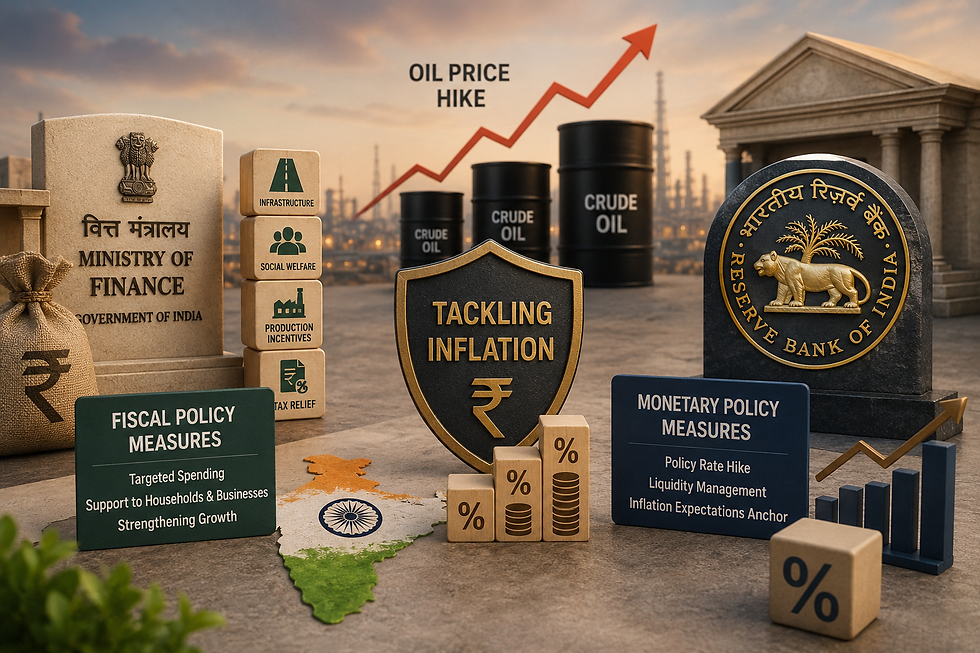
One commodity — oil — and its ripple effects touch almost every bill you pay. Economists call this phenomenon “imported inflation”: price pressure that originates outside the country’s borders and arrives through trade. This is the first part of a two-part article that covers how oil prices move through the economy. The second part on what governments and central banks do in response, and why it eventually shows up in your budget and perhaps even in your loan statements will succeed this article.
Sources and references are linked in the article and a glossary of relevant economic terms is given at the end of this article.
The cascading effect of oil shock
How does Brent crude impact your budget? The Strait of Hormuz handles roughly one-fifth of global oil trade and around one‑fifth of global LNG trade. Around one-sixth of India’s total merchandise imports transit directly or originate in the Strait of Hormuz. Brent crude, the benchmark for oil trade, touched USD 110 in April. As Brent crude rises, that higher fuel cost quickly shows up in what it takes to move goods across India.
Road transport handles over 70% of the nation’s freight movement in India. So, whether you are a homemaker in Bangalore ordering Ratnagiri mango off an e-commerce app or a manufacturer in Noida transporting raw material from a port in Gujarat, the goods have travelled a substantial distance by road to reach their destination. An increase in Brent crude means the gap between what you budgeted and what you actually spent just got wider — your margins just became tighter.
A crude oil shock rarely limits itself to fuel. The global polymer resin market, a petrochemical derivative, is also affected. A Plastics Today report notes that in parts of Southeast Asia, domestic polymer prices jumped by 50% to as much as 100% between March and April 2026, as supply disruptions tightened resin markets. The cost of food grade packaging, shampoo pouches, bottles for your edible oil – made from this polymer resin – has almost doubled in the span of 3 months.
Reuters reported that Hindustan Unilever, Dabur, and Godrej have already rolled out price hikes, with Britannia preparing a similar move and some firms trimming pack sizes instead — all part of an effort to protect margins in a cost-sensitive market under inflationary pressure. Parle G biscuits have been priced at Rs 5 for a few decades now – in 1994 Parle G cost Rs 4 for 100 grams and in 2026, for Rs 5 you get only around 50 grams. The psychological price barrier has never been breached but the quantity has been consistently reduced to make margins work.
The blockage of the Strait has caused not just a shortage of crude oil and LPG but also resulted in a supply chain challenge. Risk of logistics in a war zone has hijacked insurance premiums. Rerouting through alternative routes costs higher and causes delays. Businesses in India whose input materials travel this route now have to face both higher costs and longer delays in procurement. Global conglomerates can afford to rework their supply chains but a small manufacturer faces an existential crisis.
The domino effect of the present crisis is reaching out to the future too. India is the world’s second‑largest consumer of fertilisers and is import‑dependent for both finished products and raw materials. Fertiliser production in India depends heavily on imported inputs: natural gas for urea, and imported ammonia, phosphate rock and phosphoric acid for complex fertilisers such as DAP and NPK. A large share of these fertilisers and their inputs is sourced from the Gulf region. Imports from North Africa also transit through the Strait. According to media reports, around sixteen India-bound fertilizer ships are stranded near the Strait. As farmers prepare for the Kharif season, a scarcity of these products would mean higher input costs and even more expensive vegetable prices next season. The Department of Fertilisers has stated current stocks are adequate for the Kharif season — though a prolonged conflict, as we witnessed with fuel, would erode that buffer over time. In hindsight, tomatoes at Rs 50 per kg might look affordable.
The official data is already hinting at inflationary movement in the economy. Retail inflation in May 2026 was 3.93%, up from 3.48% in April, mainly due to rising food and fuel costs. Within that, food inflation moved up to about 4.78% from 4.20% in April, signalling that food prices are already rising faster than a month earlier. In its June 2026 report, RBI has projected inflation for FY27 at 5.1%, higher than its earlier estimate of 4.6%, explicitly citing global uncertainties and inflation risks. Once inflation shows up in everyday prices, it rarely stops there. It seeps into wages, EMIs and the rupee, forcing the RBI to act before a passing shock hardens into a permanent problem.
Part 2 of this piece looks at exactly what the RBI and the Government can do about it.
Glossary:
Cost-push inflation: occurs when the overall price of goods and services rises due to increased costs of production, such as wages and raw materials.
Imported inflation: is a specific type of cost-push inflation that occurs when overall price of goods and services rises due to fluctuations in the global prices of a commodity.
Shrinkflation: is a stealthy business practice where companies reduce the size, weight, or quantity of a product while keeping the retail price exactly the same.
Retail inflation: is the total change in the price of all goods and services an average person buys. It is measured by Consumer Price Index in India.
Food inflation: measures price changes of edible items and is a subset of retail inflation.


Comments